
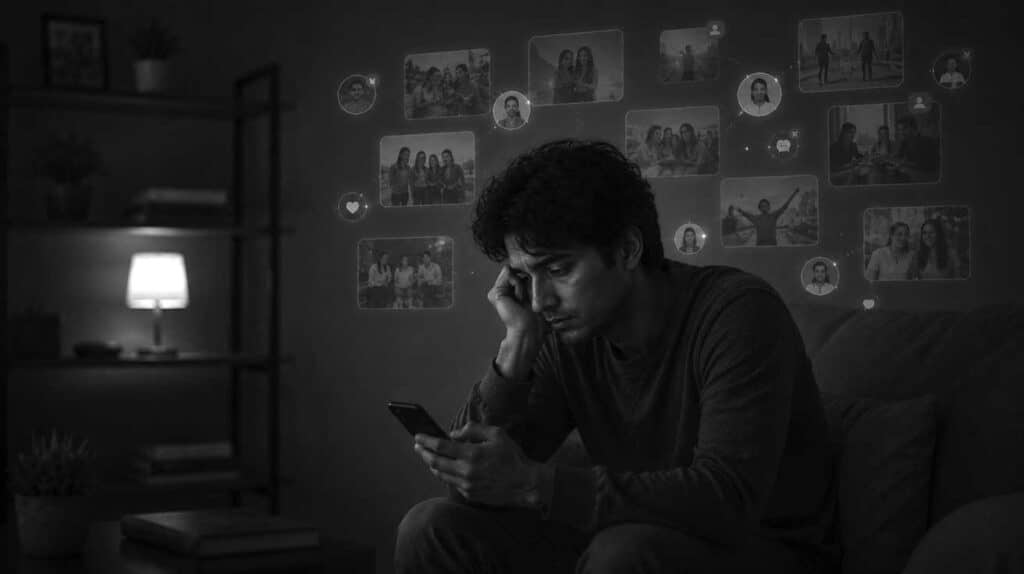
How does social media create "illusory" social connections?
Social media platforms have evolved to provide an environment where users may interact with others. Despite these advances, however, there appears to be a growing trend of people reporting feeling lonelier. The most prevalent response I receive from my patients As a psychology professional, when they describe their social media behavior is this: "I scroll endlessly, yet I feel empty afterwards."
Adolescents, young adults, and working professionals in India and other parts of the world appear to be particularly affected by this phenomenon. In essence, digital platforms offer more opportunities for interaction; nonetheless, they do not necessarily result in greater emotional connectivity.
Definition of Social Media-Induced Loneliness
Despite extensive use of social networking sites, social media induced loneliness is defined as a feeling of emotional void or lack of emotional attachment/connectedness. This occurs because of social comparisons, superficial interactions and the reduced likelihood of developing meaningful emotional bonds with others in Face-to-Face settings.
Key points:
Social media provides more avenues of contact.
However, it doesn't consistently promote relationships.
Research published in the American journal of preventative medicine states that higher levels of engagement on social media is linked to increased self-reported loneliness, specifically among younger adults who are active on social networks for more than two to three hours per day.
Why does social media lead to increased levels of loneliness?
1. Most users experience a one-way emotion through passive use.
Users are largely passive users of social media. Therefore, instead of engaging with other users emotionally, users observe other users' experiences (e.g., others' happy occasions, etc.) and consume a large amount of information presented in a curated format. As such, passive use results in a one-way emotion, which ultimately contributes to increased feelings of alienation.
2. Social media creates an unconscious comparative feeling.
Unquestionably, one of the greatest psychological effects of social media is comparative thinking. People tend to make comparisons based on the following criteria:
- Their own life vs. Others' highlight reels
- Their problems vs. Others successes
- Their physical appearance vs. Edited photos.
Such comparisons result in feelings of Inferiority and doubt about oneself, along with emotional detachment.
Although individuals may unconsciously engage in comparison and thus impact their moods negatively, even conscious comparison has the potential to create significant negative emotions.
3. Curation of Reality on social media is rarely representative of real-life emotions.
For example, social media rarely shows the true emotional reality of its users. What users typically view includes:
- Celebrations
- Successes
- Happy moments
On the contrary, the following examples represent aspects of the user's emotional Reality that are seldom visible on social media:
- Struggles
- Conflict
- Loneliness hidden behind screens
This misperception gives users the impression that "everyone else is succeeding."
4. The reward cycle and subsequent drop off into an emotional low point after using social media.
Social media activates reward centers in the brain each time users obtain likes, comments, or shares.
The release of dopamine (the pleasure hormone) during each interaction creates positive feelings initially; however, users soon find themselves experiencing decreased levels of satisfaction with subsequent interactions. Users eventually experience an emotional drop-off after prolonged periods of using social media.
Together, these elements form a cycle that leaves many users feeling empty after extended use of social media.
5. Decrease in non-digital interactions.
Digital screen time also often substitutes for non-digital social interactions:
- Reduced frequency of in-person conversations,
- Decreased level of emotional bonding between users,
- Less opportunity for nonverbal communication.
Nonverbal forms of communication require Face-to-Face contact with others; therefore, digital forms of communication cannot replicate human forms of connection.
6. Fear of missing out (FOMO).
Users are exposed to various Events, gatherings, and peer Achievements while using social media. These experiences trigger:
- Anxiety
- Restlessness
- Feeling excluded
Eventually, anxiety can evolve into persistent discontentment and dissatisfaction regarding life experiences.
Signs that social media has contributed to your feelings of loneliness
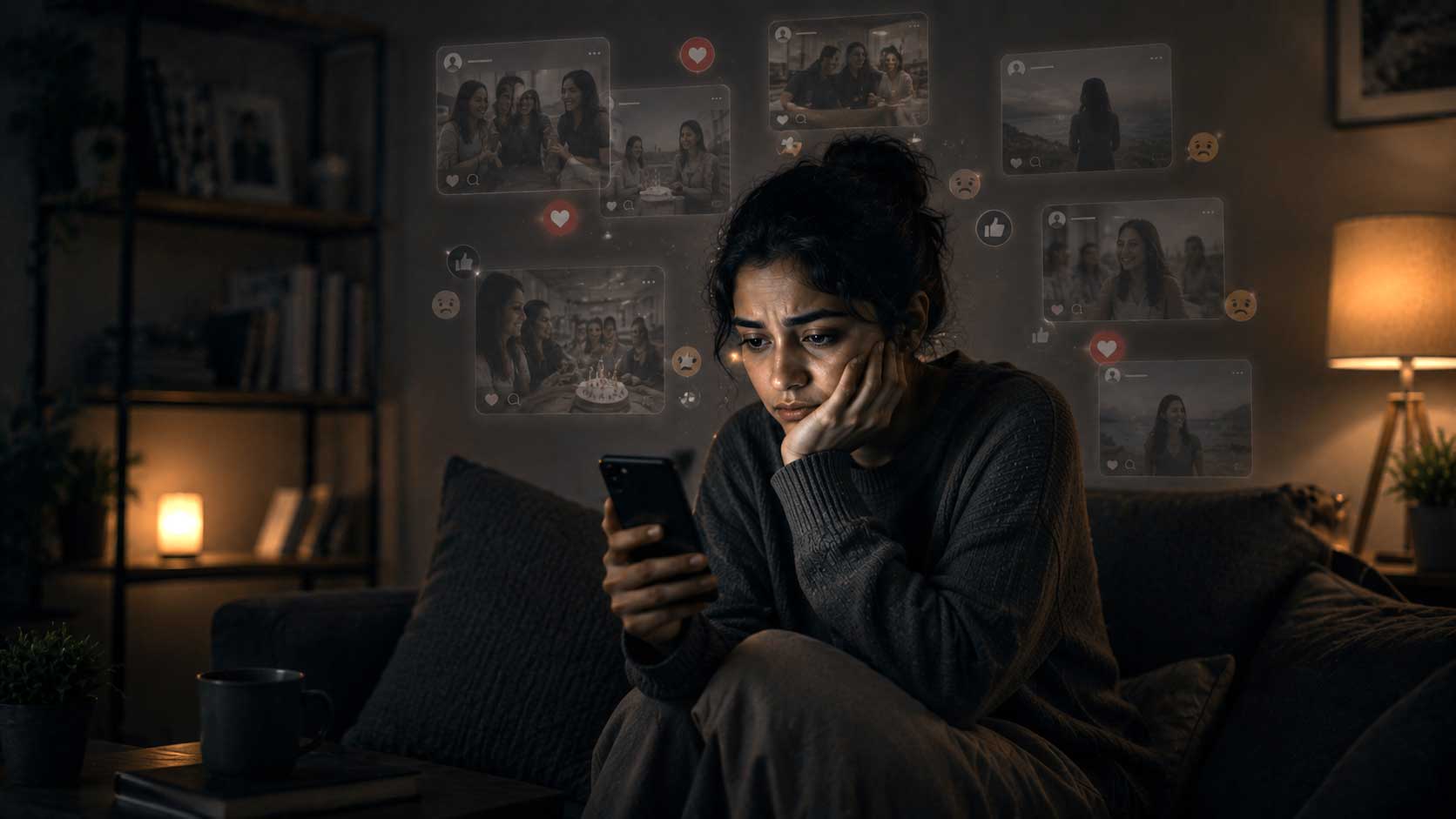
Emotional indicators
- Feelings of emptiness after using social media.
- Decreases in your mood immediately following social media use.
- Sadness or Envy when viewing other users' content.
Cognitive indicators
- Comparison with other users all the time.
- Thoughts such as "my life isn't good enough."
- Overthinking about how others reacted to posts or messages.
Behavioral indicators
- Excessive use of social media with no apparent purpose.
- Avoidance of real-life social interactions.
- Repetitive checking of notifications.
Physical indicators
- Disruptions to Sleep patterns resulting from excessive nighttime use.
- Prolonged use of screens leading to Fatigue and Headaches or eye strain.
- A critical sign is if you feel less connected to others after using social media compared to prior to using social media.
Psychological basis for digital loneliness
From a psychological perspective, social media generates illusory social presence — i.e., you perceive yourself as being socially present. At the same time:
- You feel you're socially engaged
- Your emotional needs aren't met
Studies involving Brain activity demonstrate that digital interactions activate reward areas of the Brain but fail to sufficiently engage Brain regions related to forming emotional bonds with others.
Ultimately, this imbalance over time will likely result in:
- Emotional dissatisfaction
- Shortened attention spans
- Increasingly perceived loneliness
Case Study (Anonymized)
A 19-yr-old female college student from Delhi stated that she felt increasing amounts of loneliness; although, she was very active using both Instagram and WhatsApp. She also noted that while she had numerous (hundreds) contacts online, she felt "invisible" in regards to real-world interactions. Her primary forms of communication included liking posts and sending short messages.
The evaluation indicated evidence of social comparison distress and some level of anxiety. She regularly compared her academic performance and her personal life to those of peers online.
Using an organized intervention plan (reducing screen time, promoting physical activity and other off-line pursuits, reframing comparison-related thoughts), there was a significant improvement in her overall emotional wellbeing during the course of several months. She then said, “I did not know that I was literally surrounding myself with hundreds of people online and yet disconnected internally.”
Why Social Media Can Be Addictive Yet Leave Users Feeling Emotionally Empty
Because social media is based on an intermittent reward system:
- You may receive likes sometimes.
- At times you do not receive likes.
- The uncertainty regarding when you will be rewarded for posting will continue to keep you actively engaged.
Whereas achieving emotional fulfillment involves:
- Consistency
- Depth
- Mutual Understanding
Social media typically fails to achieve at least two out of the three above.
How to Utilize Social Media While Reducing Loneliness
1. Change From Passive To Active Use
- Instead of simply scrolling through social media platforms, comment on posts.
- Have meaningful conversations with others.
- Only follow users whose posts are valuable to you.
2. Create Time Limits For Your Usage
- Set limits as to how much time you spend each day/week on social media.
- Do not scroll through social media before going to bed.
3. Reduce Triggers That Encourage Comparisons
- Remove followers/users who make you feel insecure about yourself or your life.
- Create your own curated feed.
4. Spend More Time Engaging In Face-to-Face Interaction With Others
- Meet up with friends in person.
- Spend time doing things with friends, etc.
- Participate in various off-line hobbies.
5. Take A Break From Using All Social Media Platforms At Times
- Take small breaks from all social media platforms.
- Notice whether your moods have changed and/or if you've become less focused than usual.
Important Take-Aways
- Contact increased via social media doesn't necessarily lead to a greater sense of emotional connection.
- Passive browsing leads to feelings of emotional voids due to lack of actual connection and encourages comparison behavior.
- Perception of reality is distorted through curated content.
- Dopamine driven engagement creates inevitable emotional crashes.
- Less interaction with others in the real world contributes to an increased likelihood of experiencing loneliness.
- By using social media intentionally and mindfully, one can minimize the negative effects experienced.
Why This Matters Today
Social media itself isn't damaging, it's how we choose to utilize it and what emotional needs it replaces. As long as digital-based interactions replace true human connection, loneliness will grow in spite of our being extremely connected digitally.
Recognizing the difference between these types of connections allows us to regain control over our emotional well-being.
Frequently Asked Questions
Do we get lonelier with social media?
Yes!!! Excessive passive use, and constant social comparison (even though you are "digitally" connected), can create an environment that makes you feel lonely.
Why do I feel worse after using Instagram/Facebook?
You feel worse because;
- Curated content creates comparison.
- Passive scrolling is not fulfilling your emotional needs.
How much social media use is too much?
There isn’t a set amount of time, as long as your social media usage doesn't affect how you’re feeling, how well you're sleeping, or how you interact with people in real life… then it’s probably too much.
Can reducing my social media improve my mental health?
Yes!!! Many studies have shown improvements to your mood, attention span, and even reduce your level of loneliness when you cut back on your screen time and engage with others face-to-face.