
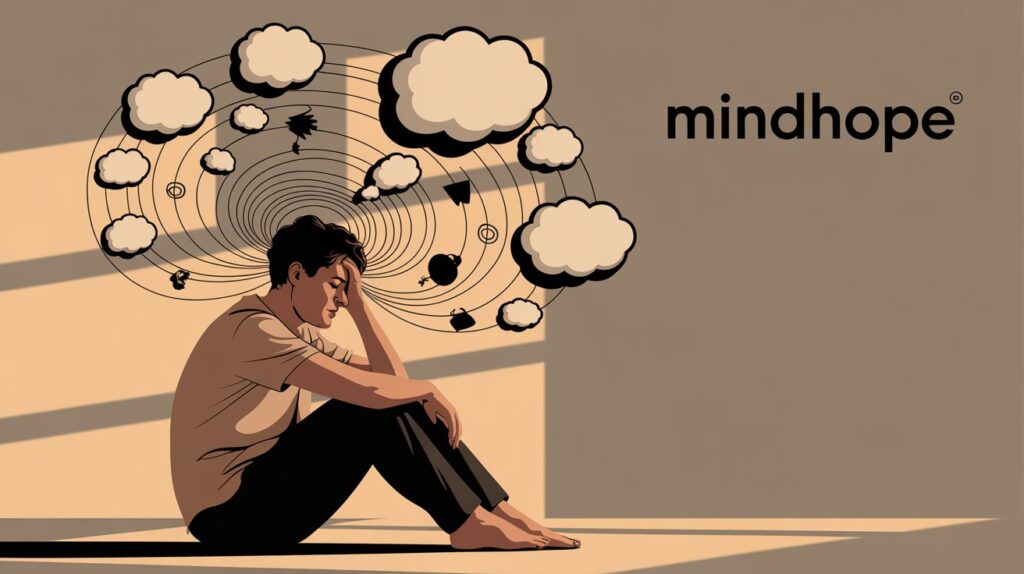
Have you ever replayed a conversation long after it ended?
Do you find yourself analysing simple decisions repeatedly, worrying about possible outcomes, or imagining problems that haven't happened yet?
If so, you're not alone.
Millions of people silently struggle with overthinking every day.
And at some point, many of them ask the same question:
“Why do I overthink everything?”
The frustrating thing about overthinking is that it often feels useful.
It feels like you're preparing. Planning. Protecting yourself.
But instead of creating clarity, overthinking usually creates confusion, stress, and emotional exhaustion.
The more you think, the more uncertain things become.
This article explores why overthinking happens, what causes it, and why the mind gets trapped in these endless loops.
What Is Overthinking?
Overthinking happens when the mind repeatedly analyses situations, conversations, decisions, or future possibilities without reaching resolution.
Instead of helping you move forward, the mind keeps returning to the same thoughts again and again.
Common examples include:
- Replaying conversations
- Worrying about future scenarios
- Second-guessing decisions
- Reading too much into messages
- Imagining worst-case outcomes
Most overthinking begins with a simple question.
Then that question creates another question.
Then another.
Eventually the mind becomes trapped in a cycle that feels impossible to stop.
Why Do People Overthink?

People often believe they overthink because they care too much.
But underneath overthinking is usually uncertainty.
The mind dislikes uncertainty.
When something feels unclear, the brain tries to solve it through thinking.
The problem is that many emotional concerns cannot be solved through analysis.
For example:
- You cannot think your way into certainty about the future.
- You cannot guarantee other people's reactions.
- You cannot eliminate every possible risk.
Yet the mind continues trying.
This creates the cycle of overthinking.
The Hidden Fear Behind Overthinking
Almost every overthinking pattern is connected to fear.
The fear may not be obvious at first.
But if you look closely, there is usually a deeper concern underneath.
Common fears include:
- Fear of rejection
- Fear of failure
- Fear of embarrassment
- Fear of making mistakes
- Fear of losing control
Overthinking often becomes the mind's attempt to avoid these experiences.
The brain believes:
"If I think enough, I can prevent something bad from happening."
Unfortunately, life does not offer that level of certainty.
So the thinking continues.
The Need For Control
Many people who overthink struggle with uncertainty more than they realise.
The unknown feels uncomfortable.
Not knowing what will happen creates tension.
As a result, the mind tries to regain control through analysis.
It reviews every possibility. Every outcome. Every scenario.
The goal is simple:
Reduce uncertainty.
The problem is that overthinking rarely creates control.
Instead, it creates mental exhaustion.
The person ends up carrying emotional pressure that never fully resolves.
The Connection Between Anxiety and Overthinking
Overthinking and anxiety are closely connected.
When anxiety increases, the brain becomes more alert.
It starts scanning for problems and threats.
Even ordinary situations can feel risky.
- A delayed reply feels worrying.
- A small mistake feels significant.
- An uncertain future feels dangerous.
This constant mental scanning keeps the mind active.
Many people notice these patterns while reading about why anxiety causes overthinking .
The more anxious a person feels, the harder it becomes to stop analysing.
How Past Experiences Influence Overthinking
Not all overthinking begins in adulthood.
Sometimes it develops from earlier experiences.
For example:
- Growing up in a critical environment
- Experiencing rejection
- Being blamed for mistakes
- Feeling emotionally unsafe
These experiences teach the mind that mistakes are dangerous.
As a result, the brain becomes hypervigilant.
It tries to avoid future pain by thinking through every possible outcome.
Over time, this pattern becomes automatic.
Many people are unaware that old emotional experiences are still influencing current thought patterns.
How Overthinking Affects Relationships
Relationships are one of the most common triggers for overthinking.
When emotions are involved, uncertainty feels stronger.
People often find themselves analysing:
- Text messages
- Conversations
- Changes in behaviour
- Tone of voice
- Social media activity
The mind tries to find hidden meaning everywhere.
Unfortunately, this often creates misunderstandings.
Overthinking can make a person feel disconnected even in healthy relationships.
Many relationship struggles become more complicated when overthinking starts replacing communication.
The Emotional Cost of Overthinking
Many people underestimate how exhausting overthinking can be.
Thinking itself requires mental energy.
When the mind never stops analysing, emotional resources gradually become depleted.
This often leads to:
- Mental fatigue
- Emotional exhaustion
- Sleep problems
- Reduced concentration
- Difficulty enjoying life
People sometimes believe they are unhappy when they are actually mentally exhausted.
You may relate to signs of emotional exhaustion .
Why Is It So Hard To Stop Overthinking?
One reason overthinking is difficult to stop is because it feels productive.
The mind believes it is solving problems.
It believes more thinking will eventually create certainty.
But most overthinking loops do not end with answers.
They end with more questions.
This creates a cycle:
- Uncertainty appears
- Thinking increases
- Anxiety increases
- More uncertainty appears
- Thinking increases again
Breaking this cycle requires a different approach.
How To Stop Overthinking
1. Notice The Pattern
Awareness is the first step.
Many people overthink automatically.
Simply recognising the pattern reduces its power.
2. Separate Problems From Possibilities
Ask yourself:
"Is this happening right now, or am I imagining it?"
This helps distinguish real issues from hypothetical fears.
3. Limit Mental Rehearsal
The mind often believes repeated thinking creates better outcomes.
In reality, excessive analysis usually creates more stress.
4. Focus On Action
Thinking and action are different.
When possible, take one practical step rather than continuing to analyse.
5. Improve Emotional Awareness
Sometimes overthinking is not a thinking problem.
It is an emotional problem.
Understanding underlying emotions often reduces the need for endless analysis.
When Support Can Help
Overthinking becomes difficult when you try to solve it using the same thought patterns that created it.
This is where outside perspective can help.
Support can help identify:
- Hidden fears
- Anxiety patterns
- Emotional triggers
- Relationship concerns
- Long-standing thought habits
Many people begin by exploring self-help tools to understand their emotional patterns.
Others benefit from structured support through overthinking counselling .
The goal is not to stop thinking.
The goal is to stop thinking in circles.
A Final Thought
If you constantly ask:
"Why do I overthink everything?"
Remember that overthinking is not a sign of weakness.
It is often the mind's attempt to create safety, certainty, and control.
The challenge is that those things cannot always be achieved through more thinking.
Sometimes clarity comes not from analysing more, but from understanding yourself better.
The more you understand what drives your overthinking, the easier it becomes to step out of the cycle.
Frequently Asked Questions
Why do I overthink everything?
Overthinking is often driven by uncertainty, anxiety, fear of mistakes, or the need for control.
Is overthinking a sign of anxiety?
Overthinking and anxiety are closely connected. Anxiety often increases mental analysis and worry.
Can overthinking affect relationships?
Yes. Overthinking can create misunderstandings, insecurity, and emotional stress within relationships.
Can counselling help with overthinking?
Yes. Counselling can help identify underlying fears, emotional patterns, and thought habits that contribute to overthinking.
If overthinking is leaving you mentally exhausted, emotionally drained, or stuck in the same thought loops, understanding the pattern is often the first step toward relief.
MindHope offers supportive guidance for people struggling with constant overthinking, anxiety, and emotional overwhelm.
Explore Overthinking Counselling