
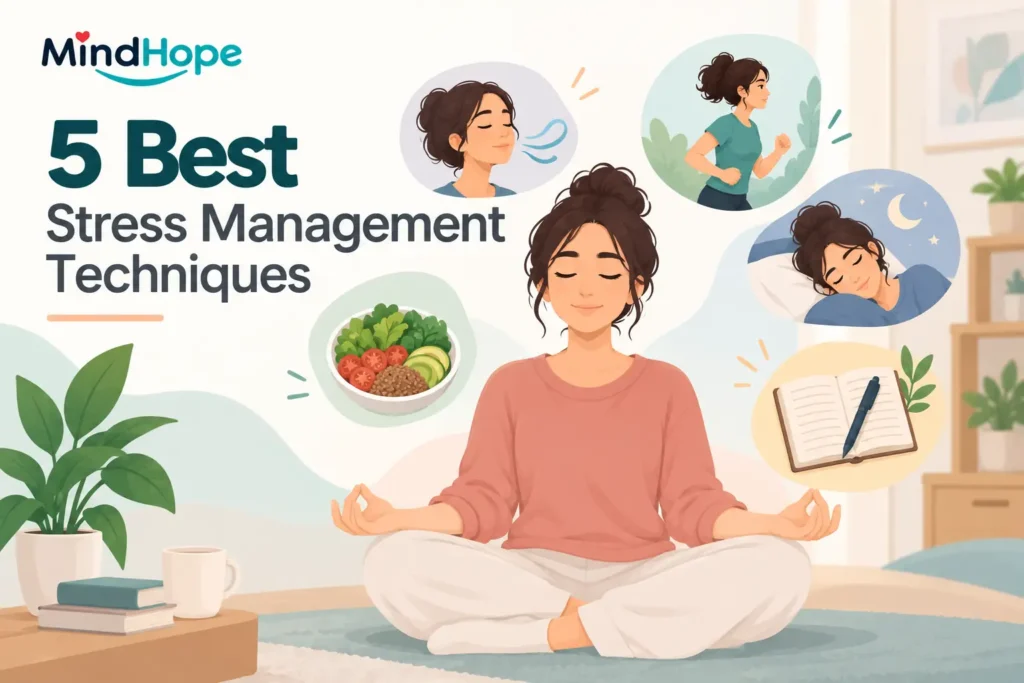
Stress is a normal part of life. A deadline, an important conversation, a sudden change in plans these are the kinds of situations your body was designed to respond to with a short burst of heightened alertness. In small doses, stress can sharpen your focus and help you act.
The problem is when it does not stop.
When stress becomes persistent when the pressure does not ease, when the worry continues even after the immediate situation has passed it begins to take a toll on your physical health, your emotional wellbeing, your sleep, and your relationships.
The good news is that stress responds well to specific, learnable techniques. This article covers five of the most evidence-backed approaches, explains how each one works, and helps you understand which might suit your situation best.
| Table of Contents1. What Happens in Your Body When You Are Stressed2. Technique 1: Diaphragmatic (Deep) Breathing3. Technique 2: Progressive Muscle Relaxation4. Technique 3: Cognitive Restructuring5. Technique 4: Regular Physical Movement6. Technique 5: Mindfulness-Based Stress Reduction7. Case Study (Anonymised)8. Which Technique Is Right for You?9. Key Takeaways10. When Should You Seek Professional Help?11. Frequently Asked Questions |
What Happens in Your Body When You Are Stressed
Understanding the physiology of stress helps explain why the techniques below work.
When you perceive a threat or demand real or anticipated your brain activates the hypothalamic-pituitary-adrenal (HPA) axis and releases cortisol and adrenaline. Your heart rate increases, your muscles tense, your breathing becomes shallow, and your body shifts into fight-or-flight mode.
This response is useful in short bursts. But when it is activated repeatedly, or when it stays on in the background without resolution, elevated cortisol levels begin to affect memory, immune function, sleep, cardiovascular health, and mood regulation.
Research published in Nature Reviews Neuroscience has shown that prolonged cortisol elevation affects the hippocampus the brain region involved in memory and emotional regulation and contributes to the development of anxiety and depression.
Every technique below works, in different ways, by interrupting or reversing this physiological stress response.
Technique 1: Diaphragmatic (Deep) Breathing
When you are stressed, your breathing becomes shallow and fast which keeps your sympathetic nervous system (the fight-or-flight system) activated.
Slow, diaphragmatic breathing does the opposite. It activates the parasympathetic nervous system the system responsible for rest and recovery and signals to your brain that the threat has passed.
A 2023 scoping review covering 15 studies found that structured breathwork techniques, including the 4-7-8 method, produced significant reductions in cortisol levels, heart rate, and self-reported anxiety. A paper published in Cell Reports Medicine found that slow breathwork produced greater improvements in mood and anxiety reduction than mindfulness meditation alone.
How to practise it
The 4-7-8 technique is one of the most accessible starting points:
- Breathe in through your nose for 4 counts
- Hold for 7 counts
- Exhale fully through your mouth for 8 counts
- Repeat for 4 cycles
The extended exhale is what activates the parasympathetic response. If 7 counts feels too long initially, use a 4-5-6 ratio and build up gradually.
Box breathing 4 counts in, 4 hold, 4 out, 4 hold is an alternative that is widely used in clinical settings and by the military for acute stress management.
When to use it
Before a difficult conversation, during moments of acute anxiety, before sleep, or any time you notice your breathing becoming shallow or your chest becoming tight.
Technique 2: Progressive Muscle Relaxation
Progressive Muscle Relaxation (PMR) is a technique developed by American physician Edmund Jacobson in the 1920s, and it remains one of the most consistently evidence-backed approaches to physical stress reduction.
The principle is simple: stress causes muscle tension. PMR works by systematically tensing and then releasing individual muscle groups, which produces a deep physical relaxation response and helps the body recognise the difference between tension and relaxation.
Multiple meta-analyses have confirmed PMR’s effectiveness for reducing physiological markers of stress, including blood pressure, heart rate, and muscle tension. It has been used successfully for stress, anxiety, insomnia, headaches, and chronic pain.
How to practise it
- Find a quiet space where you can lie down or sit comfortably
- Begin with your feet: tense the muscles firmly for 5 seconds, then release for 15 to 20 seconds
- Move progressively upward through the body: calves, thighs, abdomen, hands, arms, shoulders, face
- Notice the contrast between tension and relaxation in each group
- A full session takes approximately 15 to 20 minutes
Many people find that PMR is most effective in the evening and doubles as a technique for improving sleep quality, as it helps release the accumulated physical tension of the day.
When to use it
In the evening to wind down, during periods of high sustained stress, or when stress is presenting primarily as physical tension, headaches, or jaw and shoulder tightness.
Technique 3: Cognitive Restructuring
Not all stress comes from external circumstances. A significant proportion of it comes from how we interpret those circumstances.
Cognitive restructuring is a core component of Cognitive Behavioural Therapy (CBT). It involves identifying the specific thought patterns that are amplifying your stress response, and learning to evaluate them more accurately.
Common stress-amplifying patterns include catastrophising (assuming the worst possible outcome), overgeneralising (concluding that one negative event means everything will go wrong), and mind reading (assuming you know what others think or feel). These patterns are not character flaws. They are learned cognitive habits that the brain falls into, particularly under pressure.
CBT is one of the most extensively researched psychological interventions, and cognitive restructuring is one of its most effective components for stress and anxiety. Research consistently shows it produces durable change not just temporary symptom relief.
How to practise it
When a stressful thought appears, pause and work through these questions:
- What is the specific thought I am having?
- Is this a fact, or is it a prediction or interpretation?
- What evidence supports this thought? What evidence contradicts it?
- What is the most realistic outcome not the worst one?
- What would I tell a close friend who was thinking this?
The goal is not to force positive thinking. It is to develop a more accurate, balanced view of the situation one that does not overestimate the threat or underestimate your ability to cope.
When to use it
Particularly useful for stress driven by worry, anticipation, or repeated negative self-evaluation. Most effective when practised consistently rather than only in acute moments.
Technique 4: Regular Physical Movement
Exercise is one of the most physiologically direct stress management tools available, and one of the most consistently supported by research.
When you are stressed, your body has released cortisol and adrenaline to prepare for action. Physical movement metabolises these stress hormones in the way the body intended through physical exertion. Regular exercise also increases the production of endorphins, which improve mood, and brain-derived neurotrophic factor (BDNF), which supports neuroplasticity and emotional resilience.
A 2018 systematic review in Frontiers in Psychology found that aerobic exercise significantly reduced cortisol reactivity and subjective stress ratings, with even moderate-intensity movement producing measurable benefits. Importantly, the effects are cumulative: people who exercise regularly show a lower baseline stress response than those who do not.
What counts as movement
In the Indian context, “exercise” does not have to mean a gym membership or structured workout:
- A 20-minute walk after dinner is enough to reduce cortisol
- Yoga particularly forms that include slow movement and breathwork has a strong evidence base for stress reduction
- Climbing stairs, cycling to nearby destinations, or household physical activity all count
- Any sport, even occasional play, contributes to stress resilience over time
Consistency matters more than intensity for stress management purposes. Twenty minutes three to four times per week produces measurable benefit. You do not need to push hard to see results.
When to use it
As a daily or regular practice rather than an acute intervention. The stress-protective benefits of exercise build over time and are most significant when movement becomes a habit rather than a response to high-stress moments.
Technique 5: Mindfulness-Based Stress Reduction
Mindfulness-Based Stress Reduction (MBSR) is a structured eight-week programme developed by Dr. Jon Kabat-Zinn at the University of Massachusetts in the late 1970s. It combines mindfulness meditation, body awareness, and gentle movement to change the relationship between the person and their stress response.
The principle underlying MBSR is that much of the suffering caused by stress comes not from the stressor itself but from our reactive relationship to it the additional layer of worry, resistance, and rumination we add. Mindfulness practice develops the ability to observe thoughts and sensations without immediately reacting to them.
MBSR is now one of the most rigorously researched psychological interventions in existence. A 2018 meta-analysis of over 200 studies found significant reductions in stress, anxiety, and depression following MBSR, with effects sustained at follow-up. It has been adopted by hospitals, workplaces, and medical schools globally.
How to begin a mindfulness practice
You do not need an eight-week programme to benefit from mindfulness. A practical starting point:
- Set a timer for five to ten minutes
- Sit comfortably and bring attention to your breath the physical sensation of breathing in and breathing out
- When your mind wanders (it will), notice that it has wandered and bring attention back to the breath without judgment
- The returning of attention, not the absence of thought, is the practice
Apps such as Wysa’s built-in mindfulness tools provide guided sessions in Indian languages. Consistency across weeks produces more benefit than occasional long sessions.
When to use it
As a daily practice, ideally in the morning or before sleep. Particularly effective for people whose stress is driven by rumination, chronic worry, or a persistent sense of being unable to switch off.
Case Study (Anonymised)
| Case StudyA 32-year-old human resources manager from Delhi came for counselling describing persistent stress that had lasted for nearly a year.She managed a team of twelve, handled a high volume of employee concerns daily, and had recently taken on additional responsibilities during a period of organisational restructuring. She described waking most nights between 3 and 4 AM with her mind immediately active, going through the next day’s demands. She had stopped exercising and was eating irregularly. Her relationship with her partner had become strained.She had tried telling herself to “be more positive” and had read several self-help articles, but nothing had stuck. She described feeling as though she was constantly behind, regardless of how much she did.Over twelve sessions, she worked on three of the five techniques above in combination: cognitive restructuring (to address the catastrophising thought patterns that were amplifying her perception of risk), diaphragmatic breathing (as a daily evening practice and for acute moments during the workday), and a graduated return to physical activity starting with a 15-minute evening walk.Within six weeks she was sleeping through the night more consistently. Within ten weeks she reported that her perceived stress had reduced significantly and that she felt able to manage her workload without the constant sense of being overwhelmed.”I always thought I just needed to work harder,” she said. “I did not realise the techniques I was using to manage stress were actually making it worse.” |
Which Technique Is Right for You?
Different techniques suit different people and different types of stress.
| If stress is primarily physical muscle tension, headaches, a tight chest start with diaphragmatic breathing or progressive muscle relaxation.If stress is primarily driven by thoughts worry, worst-case thinking, repeated mental replaying start with cognitive restructuring.If stress has become a background state a persistent sense of being overwhelmed that does not lift mindfulness-based practice and regular physical movement build the most durable long-term resilience.For acute, immediate stress before an interview, a difficult conversation, or a high-pressure moment deep breathing is the fastest-acting tool. |
The most effective approach for most people is a combination of at least two techniques one that addresses the physical stress response and one that addresses the cognitive patterns maintaining it. If you have been struggling with persistent stress for several weeks and self-practice has not been enough, structured support from a psychologist can significantly accelerate progress.
You can explore stress counselling at MindHope or begin with a free first session to understand what kind of support would help most in your situation.
Key Takeaways
| Stress triggers the release of cortisol and adrenaline, which when sustained affect sleep, immunity, mood, and cardiovascular health.Diaphragmatic breathing activates the parasympathetic nervous system and is the fastest-acting technique for acute stress.Progressive Muscle Relaxation systematically reduces physical tension and is particularly effective for stress that manifests in the body.Cognitive restructuring addresses the thought patterns that amplify stress and is a core component of evidence-based CBT.Regular physical movement metabolises stress hormones and builds long-term emotional resilience.Mindfulness-Based Stress Reduction changes the relationship to the stress response and has a strong research base for sustained benefit.A combination of techniques is more effective than any single approach used in isolation.If stress has been persistent for several weeks and is affecting daily functioning, professional support is worth seeking. |
When Should You Seek Professional Help?
Self-practice techniques are effective for everyday stress and can produce significant benefit when used consistently.
Consider speaking to a mental health professional if:
- Stress has persisted for more than two to three weeks without significant relief
- It is affecting your sleep, work, relationships, or physical health
- You notice that nothing you try seems to make a meaningful difference
- Stress is accompanied by persistent low mood, anxiety, or thoughts of hopelessness
- You are using alcohol, substances, or other avoidance behaviours to manage
A psychologist can help you identify the specific patterns sustaining your stress and work through them in a structured way. Structured therapy for stress typically shows meaningful benefit within eight to twelve sessions.
Frequently Asked Questions
What is the most effective technique for managing stress?
Research does not support a single “best” technique effectiveness depends on the type of stress, the individual, and how consistently the technique is practised. For most people, a combination of a breathing or relaxation technique with a cognitive approach produces the strongest results. For long-term resilience, regular physical movement and mindfulness practice are consistently supported by the research.
How quickly do stress management techniques work?
Breathing techniques can produce a measurable reduction in physiological stress markers within a single session. Progressive Muscle Relaxation and mindfulness typically show cumulative benefit over two to four weeks of consistent practice. Cognitive restructuring requires more deliberate practice but tends to produce the most durable change for stress driven by thinking patterns.
Can stress management techniques replace therapy?
For everyday stress and mild to moderate presentations, self-practice techniques can be highly effective. For stress that has persisted for several weeks, is significantly affecting daily life, or is accompanied by depression or anxiety, these techniques work best as a complement to professional support rather than a replacement for it. A psychologist can help identify the underlying patterns and adapt techniques to your specific situation.
Is meditation the same as mindfulness?
Mindfulness is an umbrella term for a set of practices that develop present-moment awareness, of which meditation is one component. MBSR also includes body scan practices, mindful movement, and the application of mindfulness principles to everyday activities. Formal meditation (sitting quietly with attention on the breath) is a useful entry point, but mindfulness practice extends beyond it.
Can stress be completely eliminated?
No and attempting to eliminate all stress entirely is neither possible nor desirable. Some stress (eustress) is a natural and healthy response to challenge and motivates performance. The goal of stress management is to reduce the frequency and intensity of unhealthy stress, build greater resilience to pressure, and prevent the physiological and psychological harms of chronic stress.
Sources
1. Nature Reviews Neuroscience Prolonged cortisol elevation, hippocampal effects, anxiety and depression https://www.nature.com/articles/npp2015171
2. ResearchGate / Scoping Review 2025 4-7-8 breathing technique: 15 studies, cortisol and HRV outcomes https://www.researchgate.net/publication/394625657
3. Cell Reports Medicine (2023) Breathwork vs mindfulness: mood and anxiety outcomes https://prenuvo.com/blog/these-3-breathwork-exercises-will-reduce-your-stress-and-anxiety
4. Frontiers in Psychology (2018) Aerobic exercise and cortisol reactivity: systematic review https://www.frontiersin.org/articles/10.3389/fpsyg.2018.00509
5. JAMA Internal Medicine (2014) / MBSR meta-analysis 200+ studies, reductions in stress, anxiety, depression https://jamanetwork.com/journals/jamainternalmedicine/fullarticle/1809754
6. American Psychological Association Progressive Muscle Relaxation: evidence and application https://www.apa.org/topics/stress/body