
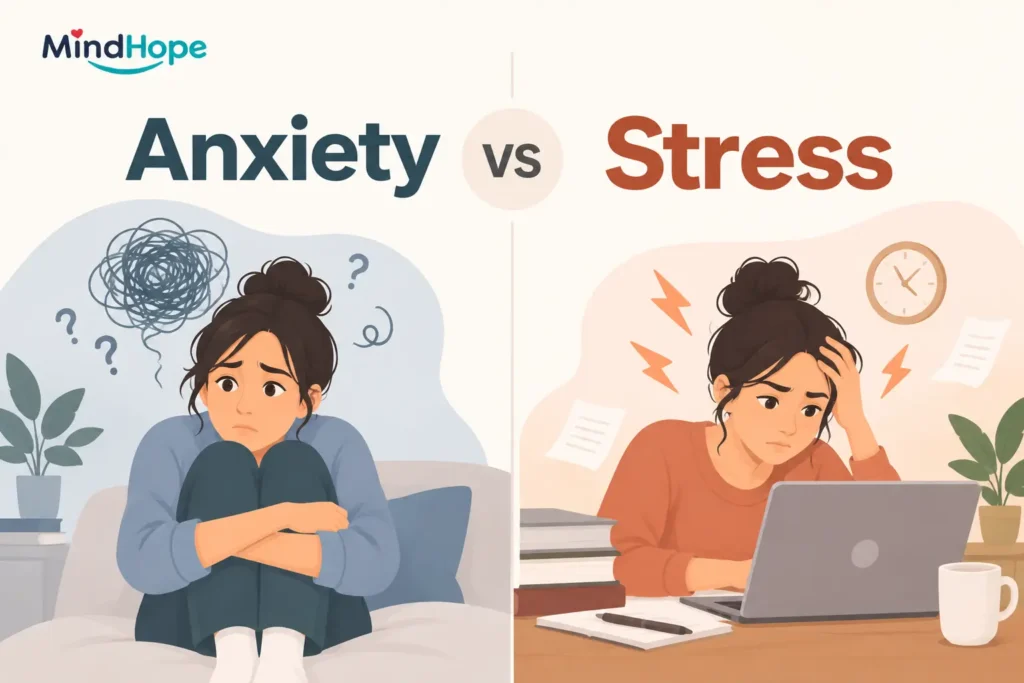
Stress and anxiety are two of the most commonly used mental health terms in everyday conversation.
Most people have experienced both at some point. Yet many use these words interchangeably, as though they describe the same thing.
In some ways, that makes sense.
Both can cause a racing heart. Both can disturb sleep. Both can make ordinary days feel harder than they should.
But stress and anxiety are not the same experience, even though they often feel similar.
Understanding the difference is not about using the correct terminology. It is about recognising what your mind and body are actually responding to, so you can choose the right approach to feel better.
What Is Stress?
Stress is your mind and body’s response to an external demand or pressure.
It has a source you can usually identify.
A work deadline. A family conflict. Financial pressure. An important exam. A difficult conversation you are dreading.
When you face a situation that requires more from you than usual, your brain signals the release of stress hormones, including cortisol and adrenaline. Your heart rate increases. Your focus sharpens. Your body prepares to respond.
This is a natural and, in short bursts, a useful response. Stress can motivate you to act, prepare, and push through difficult situations.
The problem begins when the stressor does not go away.
When pressure continues for weeks or months without adequate rest or relief, the body remains in a heightened state for too long. Over time, this can affect sleep, concentration, emotional regulation, and physical health.
According to research published in StatPearls (NCBI, 2024), prolonged activation of the stress response leads to poor concentration, irritability, fatigue, and disrupted sleep and can eventually contribute to anxiety or burnout.
The key characteristic of stress is that it is usually connected to something real and present. When the situation changes, the stress often changes with it.
What Is Anxiety?
Anxiety is also a response to perceived threat. But unlike stress, anxiety does not always require a real or immediate cause.
Anxiety is more internal. It is driven by your nervous system anticipating danger, even when the situation may not actually be dangerous.
You may feel anxious without being able to point to a clear reason. Or you may feel a level of worry that seems out of proportion to what is happening.
Anxiety tends to persist. Even after a stressful situation has passed, the worry continues. The mind keeps returning to “what if” questions about the future.
It is also anticipatory. You are not just responding to what is happening now. You are dreading what might happen next.
According to the University of Colorado Health, anxiety-related symptoms often persist after the circumstance has resolved and can feel difficult to manage long-term. This often causes people experiencing anxiety to avoid situations or activities that may trigger discomfort.
Anxiety is not simply stress that has lasted longer. It is a different pattern in how the nervous system responds to uncertainty.
Key Differences Between Stress and Anxiety
| Factor | Stress | Anxiety |
| Primary cause | External situation or demand | Often internal or unclear |
| Duration | Eases when the situation does | Persists beyond the trigger |
| Proportion | Usually matches the situation | Often larger than situation warrants |
| Direction | Pushes you to act | Often leads to avoidance |
| Physical signs | Tension, fatigue, focus | Restlessness, racing heart, dread |
| Thoughts | “I need to handle this” | “Something is or will go wrong” |
| Resolution | Improves when circumstances do | Requires addressing internal pattern |
| Stress has a source. Anxiety has a state.Stress points outward at a situation, a problem, a demand.Anxiety points inward at a tendency in the nervous system to anticipate and amplify threat, even when nothing is wrong. |
Signs You Are Experiencing Stress
Stress often develops in response to visible, identifiable pressure.
Emotional Signs
- Feeling overwhelmed by responsibilities
- Irritability or short temper
- Difficulty switching off at the end of the day
- Frustration when things do not go as planned
- Sense of being stretched too thin
Physical Signs
- Muscle tension, especially in the neck and shoulders
- Headaches
- Fatigue even after rest
- Disrupted sleep, particularly waking in the middle of the night
- Changes in appetite
Behavioural Signs
- Procrastinating because the task feels too large
- Reduced patience with the people around you
- Relying more on caffeine, screens, or other distractions
- Cancelling plans because you feel you cannot manage more
Cognitive Signs
- Difficulty concentrating
- Forgetting things more than usual
- Feeling mentally cluttered
- Replaying unfinished responsibilities even during downtime
One important sign of stress: when the source of pressure reduces, you feel some relief. The weight lifts, even temporarily.
Signs You Are Experiencing Anxiety
Anxiety can feel similar to stress, but its pattern is different.
Emotional Signs
- Persistent sense of dread that does not have a clear cause
- Constant worry, even when circumstances are objectively okay
- Fear about the future that feels difficult to reason away
- Feeling on edge without knowing why
- Emotional exhaustion from continuous internal alertness
Physical Signs
- Racing heart or palpitations
- Tightness in the chest
- Shallow breathing
- Nausea or digestive discomfort
- A constant sense of physical unease or restlessness
- Fatigue that does not improve with rest
Behavioural Signs
- Avoiding situations, places, or conversations that feel threatening
- Seeking repeated reassurance from others
- Difficulty making decisions because of fear of getting it wrong
- Staying busy to avoid sitting with the feeling
Cognitive Signs
- Racing thoughts that are difficult to slow down
- Imagining worst-case outcomes for ordinary situations
- Overanalysing conversations or events long after they have passed
- Difficulty being present because the mind is always in the future
- “What if” thinking that loops without resolution
One important sign of anxiety: the feeling persists even when nothing is technically wrong. The circumstances may improve, but the internal unease remains.
How Stress and Anxiety Overlap
Stress and anxiety are not always cleanly separate. They share many symptoms, and they often occur together.
Chronic stress can trigger anxiety. When your nervous system remains elevated for an extended period, it begins to activate the threat response more easily, even in situations that would not normally feel dangerous. This is how prolonged work stress can gradually develop into generalised anxiety.
Anxiety also makes stress harder to manage. When your nervous system is already primed for threat, ordinary demands feel bigger than they are. A regular Monday becomes overwhelming. A small comment from a colleague feels significant.
This overlap is one reason many people find it difficult to tell the two apart. You may be experiencing both at the same time. Understanding which pattern is more dominant helps you choose the most useful response.
Why the Same Situation Affects People Differently
You and a colleague may face the same project deadline. One of you feels motivated and focused. The other feels constant dread, cannot sleep, and struggles to eat properly.
The external situation is identical. The internal experience is completely different.
Several factors influence how each person responds:
- Previous experiences: Past situations that felt threatening can shape how the nervous system responds to similar situations later.
- Attachment patterns: How safety and security were experienced early in life influences emotional regulation in adulthood.
- Coping strategies: People who have developed helpful ways of managing pressure tend to recover more quickly.
- Physical health: Sleep, nutrition, and physical activity all affect emotional resilience.
- Social support: Having trusted people to talk to reduces the physiological impact of stress.
- Existing anxiety tendencies: Someone whose nervous system is already prone to anxiety may respond more strongly to the same stressor.
This is why comparing your response to someone else’s is rarely useful. Your nervous system has its own history, and that history matters.
The Psychology Behind Stress and Anxiety
From a psychological perspective, stress and anxiety activate the same biological system. Both involve the release of cortisol and adrenaline. Both activate the sympathetic nervous system. Both prepare the body for fight or flight.
The difference lies in what triggers that activation and how long it continues.
In stress, the trigger is a real external demand. The activation is proportionate and usually resolves when the demand does.
In anxiety, the trigger is often internal thought, an anticipation, an interpretation of uncertainty as danger. The activation continues even without an ongoing external cause, because the nervous system has learned to treat uncertainty itself as a threat.
Research published in BodySpec (2026) describes the relationship between cortisol and anxiety as bidirectional: feeling mentally stressed prompts cortisol release, and elevated cortisol in turn primes the body for anxious sensations, creating a self-reinforcing cycle that can be difficult to interrupt without targeted support.
This is why telling someone with anxiety to “just relax” or “stop worrying” rarely helps. The anxiety is not a thinking error that can be corrected by reasoning. It is a pattern in the nervous system that requires a different kind of response.
Case Study (Anonymised)
| Case StudyA 27-year-old marketing professional from Bengaluru sought counselling after several months of feeling constantly on edge.She described feeling stressed about her workload, her relationship, and her finances simultaneously. No single problem was catastrophic, but everything felt heavy, and she could not switch off.During sessions, it became clear that even when her circumstances improved, a positive review at work, a good weekend with her partner the underlying sense of dread did not lift. She continued to anticipate that something would go wrong. She avoided social situations because the preparation felt too tiring. She checked her phone repeatedly for signs that something had changed for the worse.Her initial belief was that she was “just stressed.”Careful assessment revealed a pattern consistent with generalised anxiety that had developed against a background of extended work pressure.Through Cognitive Behavioural Therapy (CBT) and structured stress management, she gradually learned to identify the thought patterns sustaining her anxiety, reduce avoidance behaviours, and build greater tolerance for uncertainty.Within three months, she reported meaningful improvements in sleep, emotional regulation, and her ability to remain present in daily life. |
How to Manage Stress and Anxiety
If What You Are Experiencing Is Primarily Stress
1. Identify and, where possible, address the source
Stress responds to practical changes. Where you can reduce the pressure by delegating, asking for help, adjusting timelines, or communicating limits doing so is more effective than managing the symptoms alone.
2. Prioritise recovery deliberately
Stress accumulates when there is no genuine recovery between demands. Sleep, physical movement, and time away from screens and responsibilities are not rewards. They are requirements for emotional resilience.
3. Reduce inputs before trying to increase outputs
When stress is high, adding more strategies, goals, or routines often increases the burden. Sometimes what helps most is doing less for a period, not doing more.
4. Talk to someone you trust
Sharing what you are carrying reduces its weight. Social support is a consistent protective factor against chronic stress becoming something more serious.
If What You Are Experiencing Is Anxiety
1. Recognise the thought pattern, not just the feeling
Anxiety is often maintained by specific thinking patterns: catastrophising, overestimating the threat, underestimating your ability to cope. Learning to notice these patterns is the first step toward responding differently.
2. Reduce avoidance gradually
Avoidance provides short-term relief but maintains anxiety long-term. The nervous system interprets avoidance as confirmation that the situation is genuinely dangerous. Gradually facing what feels threatening, in manageable steps, is one of the most effective ways to reduce anxiety over time.
3. Work with your body, not just your thoughts
Slow, extended breathing activates the parasympathetic nervous system and helps reduce the physiological activation of anxiety. Breathing techniques, grounding exercises, and progressive muscle relaxation are useful tools for managing acute anxiety in the moment.
4. Consider structured support
CBT is one of the most evidence-backed approaches for anxiety. It addresses the thought patterns and behavioural responses that keep anxiety running, not just the symptoms. If anxiety has been present for several weeks and is affecting daily life, professional support is worth seeking.
You can explore anxiety counselling at MindHope or support for stress and burnout depending on what feels most relevant to your experience.
Key Takeaways
| Stress is a response to external demands and typically eases when those demands do.Anxiety is an internal pattern in which the nervous system responds to perceived threat even without a clear external cause.Both share physical and emotional symptoms, which is why they are often confused.The key distinction is duration and source: stress points outward; anxiety persists inward.Chronic stress can develop into anxiety when the nervous system remains elevated for too long.Anxiety responds well to structured approaches such as CBT, grounding techniques, and gradual reduction of avoidance.Both are common, both are manageable, and neither is a sign of weakness. |
When Should You Seek Professional Help?
Consider reaching out to a mental health professional if:
- What you are experiencing has persisted for several weeks without significant improvement.
- Your sleep, work, relationships, or daily functioning are noticeably affected.
- You are avoiding situations, responsibilities, or people because of how you feel.
- Anxiety or stress is affecting your physical health, persistent tension, headaches, or digestive problems.
- Self-help strategies are not producing meaningful relief.
- You feel uncertain about whether what you are experiencing is stress, anxiety, or something else.
You do not need to have a diagnosis or a clear explanation before reaching out. Simply feeling stuck, exhausted, or unable to manage is enough reason to speak with someone.
Frequently Asked Questions
What is the main difference between stress and anxiety?
Stress is a response to an identifiable external pressure and typically reduces when that pressure does. Anxiety is an internal state in which worry persists beyond the trigger, often without a clear cause. The key distinction is that stress points outward to a situation, while anxiety reflects an ongoing pattern in the nervous system.
Can stress cause anxiety?
Yes. Prolonged stress keeps the nervous system in a heightened state for an extended period. Over time, this can make the threat response more sensitive, leading to anxiety that continues even when the original stressor is no longer present.
How do I know if I have anxiety or just stress?
One useful indicator is whether the feeling lifts when your circumstances improve. Stress typically eases with the situation. Anxiety persists even when things are objectively okay, and often involves ongoing worry about the future rather than a present demand.
Is anxiety more serious than stress?
Not necessarily. Both can significantly affect quality of life when they become persistent or overwhelming. Chronic stress can be just as harmful as anxiety over time, particularly when it leads to burnout, physical health problems, or emotional exhaustion. Both deserve attention.
Can anxiety go away without treatment?
Mild anxiety sometimes resolves on its own, particularly when it is linked to a specific situation that passes. However, anxiety that has persisted for several weeks, involves avoidance, or is affecting daily life tends to require structured support to resolve. Without intervention, anxiety patterns can deepen over time.
What kind of therapy helps with anxiety?
Cognitive Behavioural Therapy (CBT) is one of the most extensively researched approaches for anxiety. It addresses the thought patterns and behavioural responses that maintain anxiety, rather than simply managing symptoms. Other approaches, including acceptance-based therapy and mindfulness-based interventions, can also be effective depending on the individual.
Sources
1. StatPearls, NCBI (2024) Physiology of Stress Reaction https://www.ncbi.nlm.nih.gov/books/NBK541120/
2. University of Colorado Health (2019) Is It Stress or Something More https://www.colorado.edu/health/2019/09/26/it-stress-or-something-more
3. BodySpec (2026) Cortisol and Anxiety: Science, Symptoms, and Management https://www.bodyspec.com/blog/post/cortisol_and_anxiety_science_symptoms_and_management
4. Psychology Tools Fight or Flight Response https://www.psychologytools.com/resource/fight-or-flight-response
5. Medical News Today (2023) Cortisol and Stress https://www.medicalnewstoday.com/articles/cortisol-and-stress