
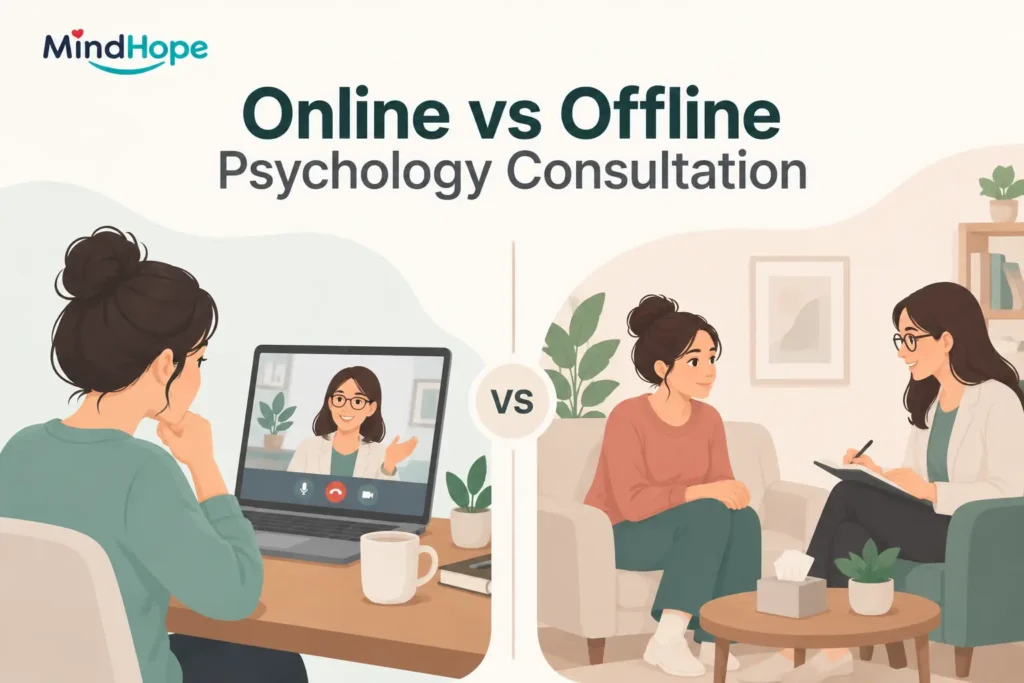
You’ve finally decided to talk to a psychologist. That alone is a significant step. But now you’re stuck at the next question: do I meet someone in person, or do I go with an online therapy session?
Both options are real, and both can help. The difference lies in how they work and which one fits your current situation. This article breaks that down clearly in simple terms, no sales pitch.
First, Let’s Clarify What a Psychology Consultation Actually Is
A psychology consultation (also called counselling or therapy) is a structured conversation with a trained mental health professional. It isn’t advice like a friend gives you. It’s a guided process where the psychologist helps you understand your thoughts, emotions, and behaviours better and work through whatever is making life harder right now.
Whether that session happens over video call or in a clinic room, the core process is the same. What changes is the setting, the logistics, and sometimes the comfort level.
What Is an Online Psychology Consultation?
An online session is a scheduled appointment with a psychologist conducted through a video call, audio call, or secure chat platform. You can do it from your bedroom, your car, or a quiet corner of your office anywhere you have privacy and a stable internet connection.
It works exactly like an in-person session in terms of structure: there’s a beginning, a middle, and an end. Your psychologist listens, asks questions, reflects things back to you, and may suggest exercises or techniques between sessions.
At MindHope, for example, online sessions with qualified psychologists are conducted the same way a set time, a real professional, and a confidential space.
What Is an Offline (In-Person) Psychology Consultation?
An offline consultation is a face-to-face meeting at a psychologist’s clinic or office. You book an appointment, travel there, sit in the same room as your psychologist, and talk.
The session content is no different your psychologist still uses the same training, the same therapeutic approaches. What changes is the physical dimension: they can observe your posture, hand gestures, and facial expressions in full, and you experience the conversation in a dedicated, clinical space.
Are They Equally Effective? What Research Actually Shows
This is the most important question, and the answer is reassuring: for most common mental health concerns, online and in-person therapy produce comparable results.
A 2023 meta-analysis published in Psychological Medicine, which reviewed over 60 randomised controlled trials, found no statistically significant difference in symptom reduction between video-based cognitive behavioural therapy (CBT) and in-person CBT for anxiety and depression. Multiple studies on Solution-Focused Therapy have shown similar findings for mild to moderate anxiety.
There are exceptions. Conditions that require clinical observation, medication management, or crisis-level care such as severe bipolar disorder, active psychosis, or acute suicidal risk are better managed in person, ideally with a psychiatrist involved. But for the issues most people new to counselling seek help with (stress, anxiety, low mood, relationship difficulties, overthinking, burnout), the research does not favour one format over the other.
Why Psychology Counselling Matters Especially in India
India has approximately 9,000 practising psychiatrists and roughly 2,000 clinical psychologists for a population of 1.4 billion meaning the treatment gap for common mental disorders like anxiety and depression exceeds 85%. Most mental health professionals are concentrated in metros like Delhi, Mumbai, and Bengaluru.
If you live in a smaller city, a town, or a rural area, offline options may simply not be accessible to you. Online consultations have changed that. A person in Gorakhpur or Surat can now speak to a qualified psychologist without travelling to the nearest metro.
This isn’t a compromise. It’s an expansion of access. And the effectiveness data supports it.
Comparing the Two Formats Side by Side
| Aspect | Online | Offline (In-Person) |
| Accessibility | Anywhere with internet; no commute | Must be near the clinic; commute cost applies |
| Privacy / Stigma | Start from home; no waiting room visibility | Dedicated clinical space; some prefer the separation |
| Cost | Generally lower; no travel overhead | Clinic fees + travel; subsidised options are rare |
| Technology | Needs device + internet + private space | No technology required |
| Non-verbal Cues | Face & voice clearly visible; body language partial | Full picture available for the psychologist |
| Crisis Suitability | Not suitable for active crisis situations | Better for crisis-level care and emergencies |
Accessibility
Online: Available anywhere with internet access. No commute, no geography barrier. Significant advantage for people in Tier 2 and Tier 3 cities, or those with mobility limitations.
Offline: Requires you to be in or near the city where the psychologist practises. Commute time and travel cost are real factors, especially in traffic-heavy cities.
Privacy and Stigma
Online: Many people feel more comfortable starting therapy from home. In India, where stigma around mental health is still a real barrier, not being seen walking into a mental health clinic matters. There’s no waiting room, no risk of bumping into someone you know.
Offline: A designated clinical space can feel safe and boundaried completely separate from home and work. Some people find this separation helps them leave the session behind when they walk out.
Cost
Online: Generally lower. No travel cost for either party. Many online platforms, including affordable counselling options, offer flexible pricing structures.
Offline: Session fees in urban clinics can be higher, and travel adds to the effective cost. Availability of free or subsidised services is limited in most parts of India.
Comfort with Technology
Online: Requires a smartphone or laptop, reliable internet, and a private space. If you’re comfortable with video calls (WhatsApp, Zoom), online therapy feels similar. If connectivity is poor or you share a room with family, finding privacy can be genuinely difficult.
Offline: No technology needed. Just show up.
Non-Verbal Communication
Online: Your psychologist can read facial expressions and tone of voice clearly on video. However, body language from the waist down, physical presence, and subtle proxemics (how people use space) are partially lost.
Offline: The full picture is available. Some psychologists feel this matters for certain types of work, particularly trauma processing or assessments that require careful observation.
Crisis Situations
Online: Not suitable if you are in active psychological crisis for example, if you are experiencing suicidal thoughts, a mental health emergency, or severe dissociation. In those moments, you need in-person support or emergency services.
Offline: Better equipped for crisis-level presentations where a clinician may need to make immediate arrangements.
What Should First Timers Choose?
Here’s a practical way to think about it:
Start online if:
- You’re new to therapy and feeling nervous or hesitant
- You live far from a qualified professional
- You want to start without anyone in your life knowing (initially)
- Your concern is anxiety, stress, low mood, relationship issues, overthinking, or burnout
- You have a reasonably private space at home
- Cost and convenience matter to you
Consider offline if:
- You’ve tried online and found the screen uncomfortable
- Your concern is more complex repeated crisis episodes, significant trauma, or something that hasn’t improved with online sessions
- You strongly prefer face-to-face contact and feel it affects how much you open up
- A psychiatrist (who manages medication) needs to be involved, and they work primarily in person
For most first-time therapy seekers in India, the realistic, evidence-supported starting point is an online consultation. It’s not a lesser version of therapy. It’s a different delivery of the same thing and for many people, it’s the only accessible version.
One Thing That Matters More Than Format
Whether you meet online or offline, the therapeutic relationship how safe and understood you feel with your psychologist is the single biggest predictor of whether therapy helps. This isn’t a soft opinion. It’s consistently what decades of psychotherapy research show.
A skilled psychologist who listens without judgment, asks the right questions, and works at your pace will help you more than the format of the session ever will.
Before choosing between online and offline, focus on this: does this psychologist feel right for me? You’re allowed to try one session and decide.
Common Questions First-Timers Ask
Will my family find out?
Not unless you tell them. Reputable platforms maintain strict confidentiality. MindHope’s privacy policy outlines how session information is protected.
What if I cry or get emotional on a video call?
That’s completely normal, and your psychologist is trained to hold space for it regardless of format. It might feel more exposed on screen at first, but most people adjust within the first session.
What issues can psychology consultation help with?
A wide range from daily stress and anxiety to relationship difficulties, career confusion, low self-esteem, and more. A useful overview is available at what problems counselling can help with.
Do I need to be diagnosed with something to get help?
No. You don’t need a formal diagnosis to speak to a psychologist. If you’re struggling even if you can’t name exactly what it is, that’s enough reason to reach out.
Is there a free option to try first?
MindHope offers a free online counselling option, which can be a low-pressure way to understand what a session feels like before committing to more.
The Bottom Line
Online and offline psychology consultations are different in logistics, not in substance. For first time patients, especially in India, where access to mental health professionals is genuinely limited online is often the more practical and equally effective starting point.
The most important move is simply to start. Whether through a screen or across a room, getting professional support for your mental health is one of the most useful things you can do for yourself.
If you’re ready, you can book a session with a psychologist at MindHope and take it from there.
Sources
1. Psychological Medicine (2023 Meta-Analysis, 60+ RCTs) via Simply Psychology https://www.simplypsychology.com/articles/online-therapy-effectiveness-research
2. National Center for Health Research Online vs In-Person Therapy Effectiveness https://www.center4research.org/does-online-therapy-work/
3. Business Standard (Oct 2025) India psychiatrist density & workforce shortage https://www.business-standard.com/health/197-million-indians-need-mental-health-support-here-s-what-s-missing-125101000277_1.html
4. Mentis Mental Health Statistics India (2026) Treatment gap 83-85% https://www.mentis.co.in/articles/current-mental-health-statistics-india.html
5. NIMHANS / National Mental Health Survey 2015-16 Treatment gap 70-92% (via NIH PMC) https://www.ncbi.nlm.nih.gov/pmc/articles/PMC9479914/
6. Anantam IAS / Parliamentary Standing Committee on Health (2023) India needs 36,000 psychiatrists https://anantamias.com/mental-health-treatment-gap/